
|
Lulu, Live at the Met and in Your Local Movie Theater
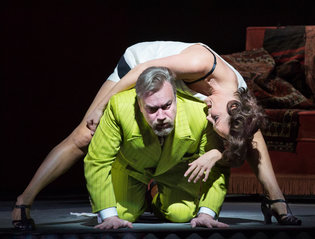 You have to consider yourself fortunate, on these cold nights when it's dark by six o'clock, that you can see a performance from the Metropolitan Opera in a movie house close to home. That would be Live at the Met, of course, the filmed opera series shown in movie theaters--"live" when the screenings take place at the same time as the performance in New York; otherwise, an "encore" performance. (According to the Met, the filmed operas are shown on more than 2,000 screens in 70 countries.) That's how I was able to see the Met's acclaimed Lulu at the cozy little Lark Theater, in Marin County, CA. Here in the Bay Area, of course, we have San Francisco Opera, which has been doing a wonderful job scheduling diverse offerings from "chestnuts" such as Rossini's The Barber of Seville (through December 9) to the upcoming double feature The Fall of the House of Usher (Gordon Getty and Debussy, December 8-13). But even SF Opera is probably not going to be mounting Lulu anytime soon; and it's a fact that the definitive Lulu of our time, Marlis Petersen, will not be performing the role here or anywhere else, since she has announced that this Lulu will be her last. Considered one of the most important theatrical works, perhaps the opera, of the 20th century, Lulu is a lurid, hard-edged tale matched by Alban Berg's "atonal" score. Berg's great teacher was Arnold Schoenberg, who developed the compositional system based on "rows" of 12 notes, replacing the specific key, centered on a specific tone, of Classical- and Romantic-era harmonies with a more jagged, modernist sound. The story is based on the Lulu plays of German playwright Frank Wedekind (who also wrote the drama Spring Awakening); with their "scandalous" critique of bourgeois society and sexual hypocrisy, the plays--Earth Spirit (1895) and Pandora's Box (1904)--were long banned from public performance. In 1925, Berg's first atonal opera, Wozzeck, caused a stir as well. Berg died ten years later, before he could finish the score for Lulu's final act; at its premiere, in Zurich in 1937, Lulu was incomplete, and stayed that way for 50 years. That version of Lulu was first performed at the Met in 1977; three years later came composer Friedrich Cerha's three-act version based on Berg's notes. Petersen has sung the role in ten productions worldwide, and what a treat it was to see and hear this dynamic German soprano embody Lulu's leg-swinging, body thrusting, man-killing ways. Always in restless, vamping motion, Lulu is both predator and prey, trapped by men's images of her and, as she says, always true to herself. The rest of the strong cast consisted of bass-baritone Johan Reuter, as Dr. Schön, who took Lulu in as a child, made her his mistress, and cannot let her go; tenor Daniel Brenna as his son, Alwa; baritone Franz Grundheber as the ancient Schigolch, who may or may not be Lulu's father; tenor Paul Groves as the Painter, one of the husbands Dr. Schön finds for Lulu; bass-baritone Martin Winkler as the animal trainer (in the Prologue) and the acrobat Rodrigo; and the great mezzo-soprano Susan Graham as the Countess--all, needless to say, obsessed with Lulu. Lothar Koenigs conducted. This production was directed by the renowned South African artist William Kentridge (his second for the Met, after The Nose, in 2010). With set designer Sabine Theunissen, he has created a complex, ever-changing series of background projections: Indian ink lines and swirls on turning, folding news and dictionary pages; woodcuts and inkblots; video of a hand making wide swooping brushstrokes--constantly moving images on partitions and walls that keep the action in a film-like, dreamy (or nightmare) realm. As much a part of the art of this opera as the singing and music, it could easily be overwhelming or hard to read from a seat at the Met. In this case, it may well have been better to see Lulu in your neighborhood theater. In addition to independent cinemas like the Lark, performances are screened at some Cinemark, Regal, and AMC theaters. Next up, at the Lark and perhaps elsewhere, from Live at the Met are two encore performances of Julie Taymor's shortened, English-language production of Mozart's Magic Flute, which kicked off the series ten years ago. Affiliated movie theaters also bring in performances direct from National Theatre London and the Bolshoi Ballet, in Moscow--culture from around the world without leaving home. The Magic Flute (Live at the Met), Dec. 12 and 16; Hamlet (National Theatre London), Dec. 13, 19, 27, and 30; Balanchine's Jewels (Bolshoi Ballet), Dec. 5, Lark Theater, 549 Magnolia Ave., Larkspur, 415.924.5111, larktheater.net. Photograph: Marlis Petersen as Lulu and Johan Reuter as Dr. Schön. Credit: Sara Krulwich/The New York Times -- This feed and its contents are the property of The Huffington Post, and use is subject to our terms. It may be used for personal consumption, but may not be distributed on a website.  More... |
| All times are GMT. The time now is 09:05 PM. |