
|
|
|||||||
| Register | FAQ | Calendar | Today's Posts | Search |
 |
|
|
Thread Tools | Search this Thread | Display Modes |
 04-07-2012, 03:13 AM
|
|||
|
|||
 Obama Embraces National Security as Campaign Issue

|
|
#1
08-06-2015, 05:22 PM
|
|||
|
|||
|
Ten Reasons NOT to Talk with Your Political Opposite
by: Jacob Hess & Phil Neisser
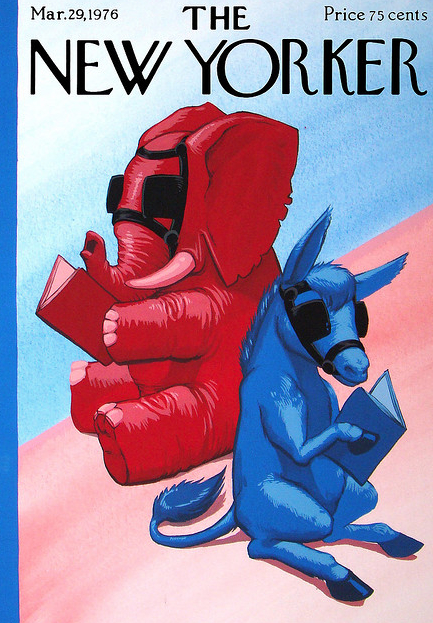 [Photo credit: New Yorker Magazine] Those in the political bridge-building community are often quick to assume that the need for more civility is something 'most Americans' readily appreciate. Do they? On the one hand, a 2013 American survey found 70% of respondents believing that incivility had reached crisis proportions in the country. On the other hand, when these same Americans are offered a chance of hearing out their own political opposite in a generous and gentle way, we have observed a striking level of resistance. One person insisted, "Most people don't want to sit and have a real conversation with their political opposite! They just don't..." Could that be true - that even though we're worried about political tensions, for different reasons we're just not going to do anything about it? We're not convinced. While there's no denying the discomfort many people do have about political discussions, we also know for ourselves that this discomfort can change over time - especially as we learn to 'sit with it' and explore it in creative ways. Perhaps the first step is simply turning towards the discomfort and beginning to see it with new eyes. In what follows, we share the ten most common examples of resistance we've observed in our work - voiced by people preferring not to engage in political conversations, especially across difference. 1. Not Wanting to Fight. Many of us simply don't want to debate or argue. In a media atmosphere where political conversations have become synonymous with "arguments," why would our experience be any different? Participants in our liberal-conservative dialogue course often said things like "this is the first conversation about gay marriage that hasn't been ugly." 2. Not Wanting to Be Distracted From the Fight. For others, participating in this kind of a conversation can feel like we're giving up on the fight. In some cases where we are committed to a fight, we can be naturally reluctant to step away from the fight, even for a moment. Indeed, this may feel like we're giving upon the fight somehow. Mark DeMoss writes that "many people equate civility in public life with unilateral disarmament" - citing Bill O'Reilly's explanation for why he wouldn't embrace civility if he were in Congress: "I'd be afraid that if my opponent attacked me I wouldn't be able to attack him back." The perception that generous conversation might harm 'your cause' is definitely alive and well. 3. Needing the Other Side to Be Monsters. Once our resentment OF 'those people' (whoever they are) is solidified, it's common to begin searching FOR stories that further justify that anger and reinforce our own sense of righteousness. As long as the 'other side' is isolated from us - it's much easier to maintain vindictive narratives. A face to face meeting with 'those monsters' definitely runs the risk of puncturing any tightly held stories. 4. Feeling Safer in Tribal War. You know that sense of power that sometimes comes when you get angry? One colleague told us "There is something in the polarization that feels reassuring - lending a sense of superiority to 'our side.'" Like monster-izing stories, deep resentments can perpetuate tribalizing divisions that may somehow help us feel more safe and secure. After all, we're the 'good guys,' right? 5. Not Wanting to Risk Shifting Our Own Convictions. A big reason we avoid cross-political conversations is what might happen if we actually open ourselves to listen to 'those people'? And it's true: you might learn something! Although we rarely see anything resembling a conceptual 'conversion,' the threat of (some) perspectives evolving is a legitimate risk - and one that some aren't sure they are willing to make. 6. Feeling Like We've Heard Enough from 'Those People.' Others may feel they've been listening plenty and they 'already know what the other side thinks...' Who needs another conversation when you've already got those people 'figured out'? 7. Not Wanting to Waste Time. More broadly, it's easy to wonder what the point of a conversation like this would be: 'what's talking going to do anyway?' Why not focus our energies on actually 'doing something ' rather than 'just talking'...? 8. Seeing Dialogue as a Liberal Tool. Conservative-leaning people sometimes see public calls for dialogue as part of the 'liberal agenda' for changing society - as some kind of an "educational tool" being used exclusively to "promote diversity, social justice, and social change." 9. Seeing Dialogue as a Conservative Tool. Likewise, liberal-leaning people sometimes see dialogue as reinforcing the status quo norms - pointing to historical instances where a simple invitation to 'talk' has functioned to placate the angry, subvert intended action or muffle dissent. 10. Feeling Too Darn Busy! Other reasons aside, this last one is arguably the biggest factor. With the schedule Americans keep, who has time for anything 'extra' like this, anyway? The one moment that many Americans report getting to stop is when they are alone on the toilet! When you add all these factors up, no wonder people are pushing back from political bridge building conversations! Even if we did have time and energy for the conversation - the combination of fears and concerns make this start to seem like an extreme sport. "Hey - would you like to take road bikes and jump across a ravine?" Let me check..."no thanks!" Inviting someone into our home for any reason can be a big deal. Doing so in order to explore something political that we might disagree about, we're finding can take some real guts and courage! So why even consider this? Funny you should ask - because next week we'll be detailing the other side of the story - Ten Reasons to SET A DATE with Your Political Opposite...and trust us, you're totally going to want IN on this! (: Jacob Hess is a partner at Living Room Conversations and Director of Village Square, Salt Lake City. After helping develop the nation's first liberal-conservative dialogue course for undergraduates at the University of Illinois, Jacob co-authored with Phil Neisser a book on liberal-conservative dialogue entitled, "You're Not as Crazy as I Thought (But You're Still Wrong) Conversations between a Devoted Conservative and a Die-Hard Liberal" - featured on NPR's This American Life. Phil Neisser teaches political theory at the State University of New York at Potsdam, where he also serves as the Associate Dean of Arts and Sciences. In addition to You're Not as Crazy as I Thought, Phil is the author of United We Fall: Ending America's Love Affair with the Political Center and co-editor of Tales of the State: Narrative in Contemporary U.S. Politics and Public Policy. And in the year 2000 he received a SUNY Potsdam Presidential Award for Excellence in Teaching. Jacob and Phil are both members of the National Coalition of Dialogue & Deliberation - where they met many years ago. -- This feed and its contents are the property of The Huffington Post, and use is subject to our terms. It may be used for personal consumption, but may not be distributed on a website.  More...
|


 Linear Mode

