
|
|
|||||||
| Register | FAQ | Calendar | Today's Posts | Search |
 |
|
|
Thread Tools | Search this Thread | Display Modes |
 04-07-2012, 03:13 AM
|
|||
|
|||
 Obama Embraces National Security as Campaign Issue

|
|
#1
12-01-2015, 10:49 AM
|
|||
|
|||
In Reproach to Terror, Twyla Tharp Turns to the Gods of Order, Chaos and the Dance
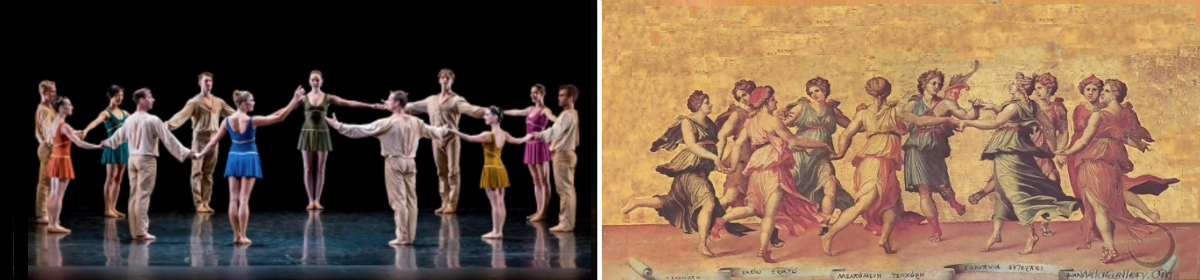 Left: Twyla Tharp's Preludes and Fugues, part of Tharp's 50th Anniversary Tour here performed at the Kennedy Center's Eisenhower Theatre, November, 2015. Photo: Sharen Bradford. Right: Giulio Romano, Dance of Apollo and the Muses, oil on canvas, Pitti Palace, Florence, ca. mid 15th century. Both works are said to be governed by the Apollonian principles of harmony and restraint applied respectively to dance as to painting. Some people respond to terror heroically. They are the first responders to an attack, those required to restore order and those who in theory seek to minimize the bloodshed. The next in line are the mediators of public record, the journalists -- writers and photographers -- who record the chaos before its devastation has been altered or remedied to establish the criteria of objectively shared accounts, always a dubitable intention, but least so when the event is ongoing or still fresh. After the chaos of immanent terror clears, the crowds take to the streets with their cameras and smart phones to impart the data to a concentric ring of receivers around the globe. Often the last to respond are the artists, though they too have been part of the larger crowd gathering record, for them the true response is one that is measured, whether spontaneously as in the case of the sketch artist, the expressionist painter or the poet, or after great durations of deliberation, as for the novelist, the screen or stage writer, and of course the longest response is that of the historian, who must put the record of events into a structural system of response years in the future making even as the terror itself is forgotten. Somewhere among the late responders stands the choreographer. While the dancer can improvise her response to a cataclysm on the spot. the choreographer must devise a language of movement that must first be conveyed to a dancer who in turn must convey it to an audience. Learning that language in the muscles is of course excruciating slow, but because of the eminence of discipline required to maintain the order of dance with precision, even in improvisation, it is the dancer who arguably delivers the most nuanced expression of emotion through an economy of human movement eminently suited for re-enacting if not the event of terror itself, certainly the emotional affects and response to the event by an entire collective all at once. Only the moving image is capable of delivering more information to more people in an instant. But only the dancer delivers the emotions and thoughts that build and bind the collective memory that becomes history with what is truly a superhuman effort. 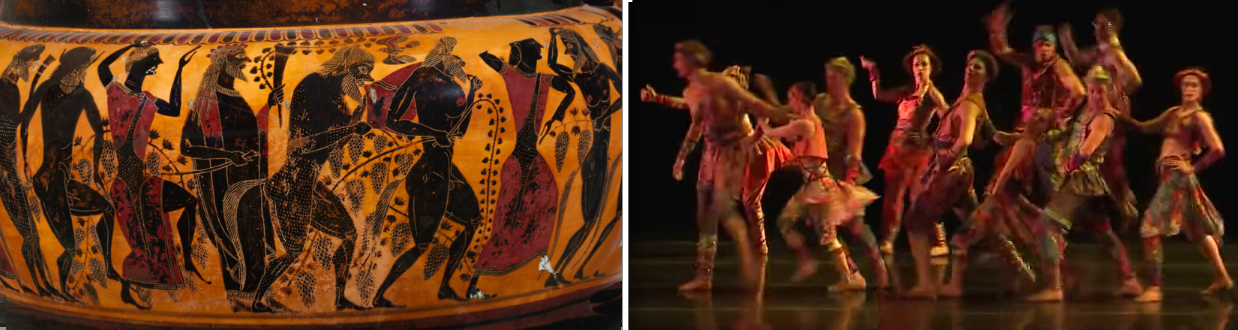 Left: Bacchanalia with Dionysus and Celebrants, terra-cotta Attic column-krater attributed to the artist Lydos, 550 BCE, Metropolitan Museum, New York. Right: Yowzie, the suite of dances Tharp offers as the alternate response to chaos, the Dionysian or desublimated collapse of formalities and sensibilities both in its display of cavalier and devolving hedonism and in the passionate expressionism and improvisation of art. Tharp's dance Yowzie is the opposite of her Preludes and Fugues in conveying the hedonistic elements in society and culture that seemingly run headlong into chaos and when plied with intoxications into oblivion. Twyla Tharp's 50th Anniversary Tour may have ended in the US with November, but the imagery that she imparted through her dancers to American audiences throughout the autumn of 2015 has the lingering resonance of great art. Such a resonance is only in part the effect of the bitter irony that the dances Tharp premiered on her 17-city tour of the US both grow out of the 9/11 terror in New York that she and her dancers then lived through, and which she spent thirteen years to cathartically relay to her New York audiences the very week they were rattled by an Islamic State video taunting New Yorkers with the threat of an immanent attack like that unleashed on Paris November 15. Even had the irony of such tyrannical confluences not convened on her New York premiere, Tharp's anniversary dances would just as likely remain distinctive in the history of modern dance by offering its audience two opposing if historically-conjoined and iconic images to consider as responses to terror -- both grown not just from the threat of modern terror, but in their recall of two universally opposing modes of responses to all forms of terror throughout the millennia-old history of the arts. That is, the way that artists, through their intimate knowledge of the infinite ways that materiality, time, ideas and behavior can be structurally ordered to convey meaning, can effect an art that appeals to either Order or Chaos. An artist is inspired simultaneously by models of order and chaos. One cannot occupy the mind without appealing to its apparent opposite -- if opposite is what they are. To the thinking person, they necessitate one another. Which is why they became personified by gods in various tribes and civilizations. But the gods will come into play shortly. 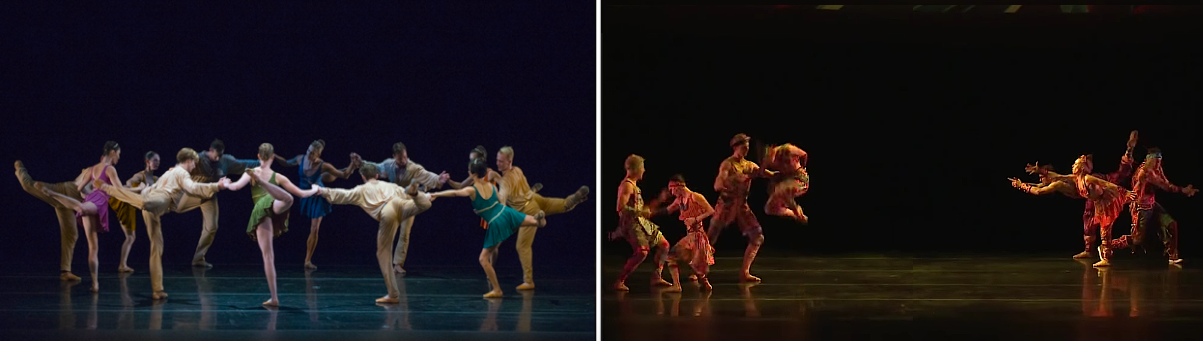 Left: Preludes and Fugues, performed as part of Twyla Tharp's 50th Anniversary Tour at the Winspear Opera House, Dallas, September, 2015. Photo: Robert Hart/TheaterJones. Right: Yowzie performed at the David H. Koch Theater at Lincoln Center in new York. Contrasting Tharp's dialectical pairing of the Apollonian and sublimated character of classical ballet and the freeform Dionysian and desublimated expressionism of much modern dance. Tharp informs us that the dances she premiered in 2015 were seeded in her body as she reeled from the imagery of the airplanes crashing into the World Trade Center towers. Her dance company had been the last performers to entertain audiences in the outdoor plaza on September 8. Perhaps the incomprehensibility of so utter and complete an annihilation of great cultural symbols is magnified for those who have been in physical or temporal proximity to them. Amid the devastation, Tharp reached for the distance and order that she knew is supplied by the daily drill of dance. A serious dancer or athlete knows that not a day can go by without the maintenance of order in the body through a repetitive regime of self-denying discipline. Perhaps they know better than anyone how near at hand the impulse is to collapse into a hedonism of pleasure, eros and intoxication. Such a discipline in a nation founded on the Protestant work ethic may seem hardly out of the ordinary, but in counterpointing it forcefully with its opposite cultural archetype -- the evil intoxicant, lascivious and even criminalistic hedonism that in is the coping mechanism of millions intended to tune out the oppression meted out by unseen warriors and even embrace the oblivion toward which they believed themselves both liberated and destined. It is this intimacy between discipline and hedonism that in the wake of the terror around her, Tharp also became acutely aware of the corresponding intimacy between order and chaos. Perhaps the specter of Martha Graham also haunted her, given that as Tharp was nearing the age that forced Graham to retire from dancing due to chronic arthritis, a bout that propelled her into alcoholism. Speculation aside, for whatever reason, Tharp declined to make dances illustrative of or addressing the terror itself. To have done so would be to immortalize the assault and its perpetrators while perpetuating its offense. Commemorating the dead, though noble, appears not to have been Tharp's intent either. 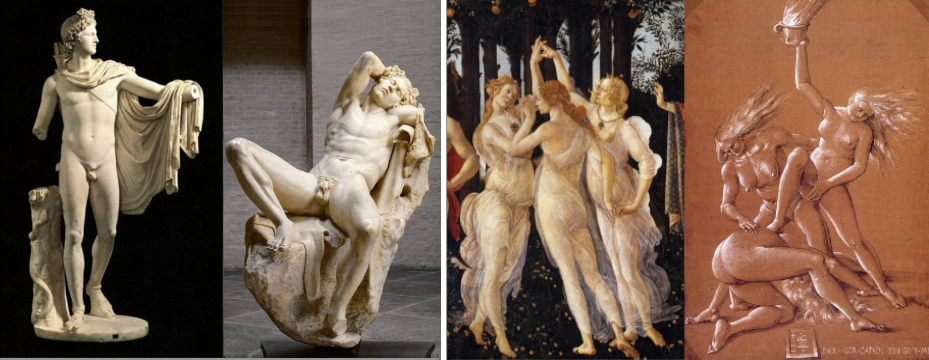 Nietzsche derived from the classical and expressive contrast in Greek art and theater the opposing principles of the Apollonian and the Dionysian manifest in the iconography of sculpture and painting. Left: Apollo Belvedere, Vatican Museum, Rome, ca. 350 BCE, marble, the paragon of classicism and restraint in Greek sculpture. Left center: Barberini Faun or Drunken Satyr, ca. 320 BCE, marble, Glyptothek, Munich, Germany, epitomizing the Dionysian relaxation of restraints taken to the experience of near-oblivion. Right center: Sandro Bootticelli, detail of the Three Graces from Primavera, 1482, tempera on panel, Uffizi Gallery, Florence, Italy, the epitome of Apollonian classicism in Italian Renaissance painting. Right: Hans Baldung Grien, Witches' Sabbath, 1510, chiaroscuro woodcut, British Museum, London, the Dionysian bacchanalia transferred to the Wicca ritual as vilified by Christian Renaissance morality. Tharp chose to embody the human struggle to maintain order despite the chaos that intervenes. Discipline or the lack of became both her topic and her modus operandi as she choreographed two diametrically opposed suites of dances. One portraying the disciplined proponents of order like herself. The other to portray the hedonistic, debauched, even the criminal submission to chaos that envelopes those individuals and groups unable to cope with the demands of life after annihilation, personal loss and the mounting militarism of vengeance. All of which is to say the work sought to signify the universal implications of the struggle against adversity for survival itself, with two distinctly iconic and archetypal behaviors standing out in response to all collective tragedy. The mystery was to be solved in the program notes by Robert Johnson, where he elaborates Tharp's intent for such athleticism and precision. "Back in 2001 ... the horror of the terrorist attacks left [Tharp] reeling, but reaching for balance and thinking of the initials WTC she found a compact-disc recording of The Well-Tempered Clavier. Bach's compendium of matched preludes and fugues for keyboard spark with brilliance, and recall the reassuring discipline of a musician's (or a dancer's) daily practice. For Tharp, these beautiful, sanity-saving exercises also embody diversity. As pianists move from one prelude and fugue to the next, they visit all 24 major and minor keys, traveling around the so-called 'circle of fifths,' a diagram that illustrates pitch relationships. Within this orderly progression, limitless variations are possible; and Bach demonstrates his versatility by composing pieces of varying length and by adopting different styles." Tharp had certainly attained the sanity required to endure the despair following the chaos of 9/11. To have made the dances seem in any way joyous or colorful would have disrupted the Protestantism that drove the ethos of the project. But then came the next suite of dances that not only compensated for the intent sobriety of Preludes and Fugues, it purposefully overcompensated for it with theatrical relish. 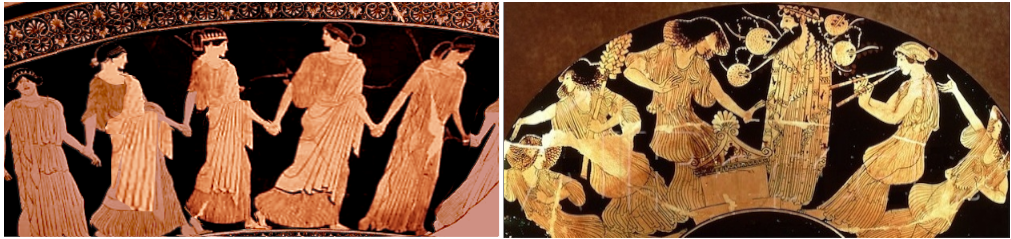 The earliest examples of the Apollonian and Dionysian sensibilities in Greek art are preserved on Attic red-figure and black-figue pottery. Left: Attic column-krater by the Villa Giulia Painter, ca. 450 BCE depicting dancing women according to the sublimated principle of Apollonian restraint. Compare with, Right: An Attic red-figure kylix depicting a herm of Dionysus surrounded by the Maenads in ecstatic ritual by the painter Makron, ca. 490-80 BCE. Posed in distinct opposition to the structure and discipline of Preludes and Fugues, the dance called Yowzie sought to collapse both in a display of cavalier and devolving hedonism -- an illusion that every dancer knows in fact requires even more discipline than the dance displaying its discipline openly to make its inherent discipline seemingly disappear. It is by such artifice that Tharp's dancers act out the theatric conventions that are something more than dance movement -- ordinary if exaggerated expressions, defensive attitudes, sociological and psychological cliches (dependence, domination, incompatibility). It is the totality of these theatrical signs in conjunction with the feigned relaxation of technical finesse of the dancers that together impart the hedonistic, even amoral predisposition for succumbing to the lewdness and intoxication the we know not just from life, but from art. In fact, by all appearances, Tharp defers to the graphic signage and descriptions of the artistic and literary history of bacchanalia. How does such a stark polarization of human temperaments respond to the tragedy of 9/11? Tharp explains that "the two pieces are at extremes of the spectrum." While the dance set to Bach affirms the artist's trust "in the power art has to substitute order for chaos", the two dances together reflect the philosopher's most elementary lesson on the difference between, in Tharp's words, "the way the world should be," and "the way the world is."  Two late-Rennaisance, early Baroque paintings depicting Bacchanalia. Left: Titian, Bacchanal of the Andrians, 1523-1525, oil on canvas, Museo del Prado, Madrid, Spain. Right: Nicolas Poussin, Bacchanal Before a Statue of Pan, 1631-33, oil on canvas, National Gallery, London. Apollonian vs. Dionysian or Sublimation vs. Desublimation As it turns out, it is from the Greek dichotomy in dance that the Apollonian and the Dionysian differentiations became realized and later increasingly pronounced. The ancient Greeks polarized the two tendencies in art and drama. Apollonian dance, we are told, was ceremonial and austere, strictly choreographed according to formal patterns and prescribed movements. They were institutionalized and thereby commemorative of power and authority, upheld tradition and esteemed order and beauty as highly intellectualized and formal qualities bestowed by the gods, especially Apollo, the god of the Sun. Dionysian dance, also known by its Roman name, Bacchanalia, were the polar opposite of everything the Apollonian dances aspired to. Passionate and improvised according to the whims of the dancer, they were the dances that the ritual intoxicants broke out to symbolize their defiance of moral and political authorities. At the peak of their popularity, Dionysian dances were orgiastic and accompanied the art of intoxication worshipful devotion to Dionysius the god of wine, dreams and wanton sexuality. Female followers inspired the myth of the maenads (or bacchae to the Romans) whose ritual intoxication produced such wild abandon as to hunt and kill wild forest and mountain animals with their bare hands while drinking their blood. And yet only the arts could be thought to appease both the gods. And as a result, both Apollo and Dionysius were favorite subjects of artists up to the modern period. In the mid-19th century, Nietzsche famously reintroduced the dialectical aspects of Apollonian and Dionysian dance and theater to modern society, projecting them as behavioral archetypes on all the arts in The Birth of Tragedy, and of civilization and culture in general. It is Nietzsche's phrasing of the Apollonian principle of formal discipline that informs Tharp's resort to Bach's Preludes and Fugues as the music through which she can flee the paralyzing terror and grief model of higher restraint and formal harmony that informed the more refined arts and sciences and the dignified and harmonious lifestyle and government. 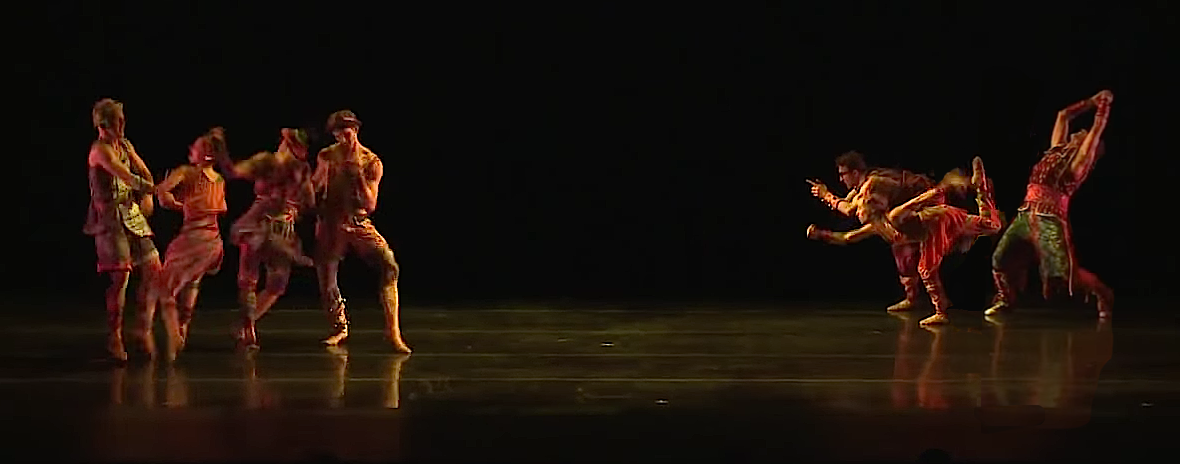 Tharp's contemporary bacchanalia dance, Yowzie, performed as part of Twyla Tharp's 50th Anniversary Tour of seventeen American cities. Yet Tharp can't bring herself to represent the complete abandon of the Dionysian non-principle in music an dance, inasmuch as she taps the improvisational sensibilities jazz immortalized by Thomas "Fats" Waller, Jelly Roll Morton and Henry Butler an adequate abandonment of refinement and restraint to evoke the forbidden, the wanton, the self-indulgent, the anarchic and spontaneous action that ultimately leads to the abandonment of the self in the intoxication of self-absorption. While all this concern with Apllonian and Dionysian sensibilities is the romanticist's terminology based on an archaic model, a more current psychological and sociological phrasing of this dichotomy of human behaviors came to be applied to society in the way that Tharp evokes in her response to terror and chaos of war is conveyed with the complimentary concepts of 'Sublimation' and 'Desublimation' derived from Freud at the beginning of the 20th century. Here it is the unconscious yet socially-enforced sublimation principle that takes charge of the moral person's education, ensuring s/he undergoes a conversion away from what Freud calls the infantile Pleasure Principle that is subdued if not entirely repressed in childhood by socially-reinforced behaviors and aims that Nietzsche described as the Apollonian order, that impetus for governments, economies and technologies as advanced as space flight and moon walks. For Tharp, the sublimated principle governs The Well-Tempered Clavier, Bach's music conducive to promoting a productive discipline and moral competency of the artist. Of course, the Apollonian discipline is also required by the higher social order and the institutions of powerful governments, including authoritarian regimes. 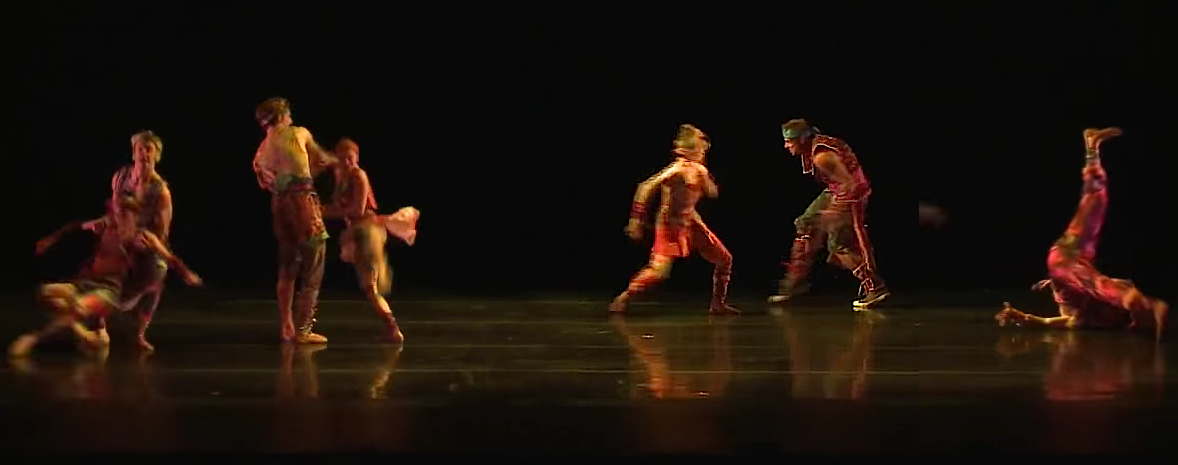 Tharp's contemporary bacchanalia dance, Yowzie, performed as part of Twyla Tharp's 50th Anniversary Tour of seventeen American cities. That Tharp doesn't end with Bach, that she reaches for the arousing jazz of Morton and Waller for her suite, Yowzie, on the other hand, indicates she hears the clarion wisdom of Ecclesiastes "to every thing there is a season, and a time to every purpose under the heaven". In this case the season calls for the Pleasure Principle of Freud, or what the political philosopher Herbert Marcuse re-conceptualized in post-Freudian terms as Desublimation, the hedonistic breakdown of discipline and moral principles in the primacy of pleasure enabled by affluent societies that was dramatically and tumultuously in dissent forced upon Western society by the youth and counterculture of the 1960s -- Tharp's generational and cultural alma mater of the street. But it's not for all these academic reasons that we might wish to appraise Tharp's 50th Anniversary dances in terms of the dialectical processes of the Apollonian-Dionysian or Sublimation-Desublimation principles. The terms are useful to helps us recall and locate the art of history that Tharp's dances emulate if not grow from, as much as they impacted on the 1960s and 1970s, the decade that Tharp began her choreographic inquiries and whose music still accompanies, perhaps even informs her dances (The Beach Boys, Bob Dylan, Frank Sinatra, Billy Joel). It is also in the 1960s that culture began widening its influences to assimilate the arts and philosophies of non-Western cultures required to better understand and ease global tensions while eradicating the superstitions and bigotries that inform terror. 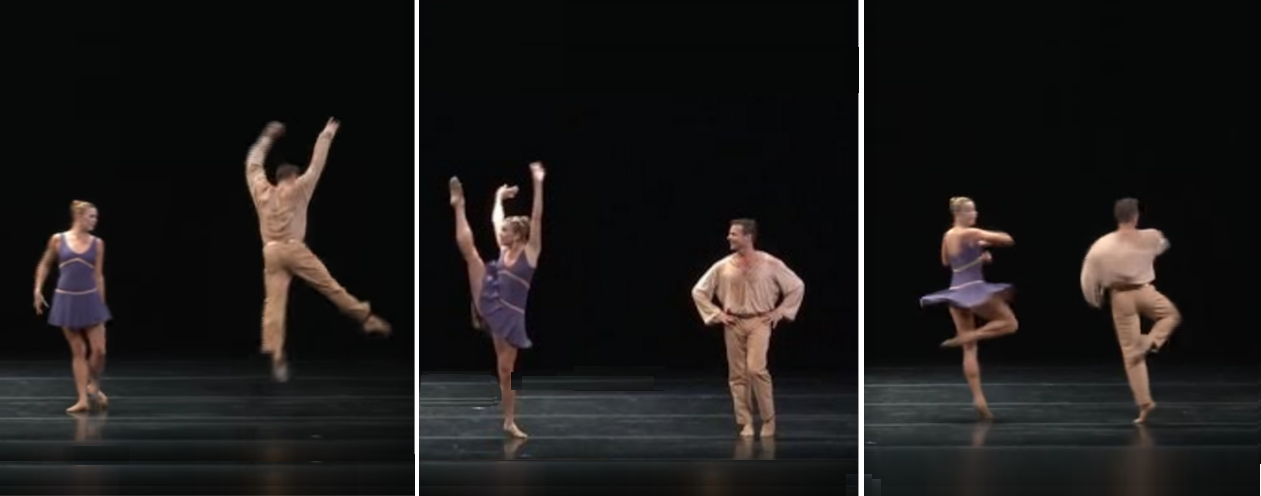 Tharp's light, ethereal, elegant duet, Diagonal, from the suite Preludes and Fugues, in its simplicity and clarity of movement embodies the Tharp's light, ethereal, elegant duet, Diagonal, from the suite Preludes and Fugues, in its simplicity and clarity of movement embodies theApollonian aesthetic. Performed as part of Twyla Tharp's 50th Anniversary Tour of seventeen American cities. Despite Tharp's misgivings about cutting to the bone of dance to portray the darkest side of the human psyche -- Tharp appears only to have had the heart to countenance the specter of chaos with the comic theatricality of vaudeville antics and the commedia dell'arte. Or perhaps her more mainstream audience crossing over from Broadway and Hollywood compelled to stop short of courting a more thoroughly existentialist angst. Given that the current taste for irony among postmodern intellectuals and the proclivity among mainstream audiences for irreverent entertainment conjoin to make it too easy for the tragedy conveyed through dance to appear overwrought, made into a gratuitous self-indulgence meant to seem imposed by Nature while it in fact betrays the human conceits that devolve too easily into melodrama. And how could Tharp not see this, considering that long before she indulged Hollywood and Broadway, she learned from such temperate and serene Apollonian masters as Merce Cunningham and his partner the composer John Cage -- artists who reduced dance and music to their bare and abstract constituents. As an artist in her own rite, Tharp's introduction to audiences was as a member of the New York avant-garde of minimalist dancers that in the 1960s grew out of the Judson Dance Theater, a milieu of visual artists, dancers, filmmakers, poets and musicians who came together for a decade and a half. With many of them born during World War II and grown up with the specter of nuclear holocaust and a fashionable Existenialist zeitgeist critique of civilization that categorized Aushwitz, Hiroshima, the Gulags and the Cultural Revolution of Beijing as proof that all the great art of history, all the Apollonian splendor, could not purge civilization of the barbarian lust for chaos. The 1960s were the last generation to loudly anticipate that a terror unleashed would again reveal itself in the West. It would take another three decades for 9/11 t prove them correct. 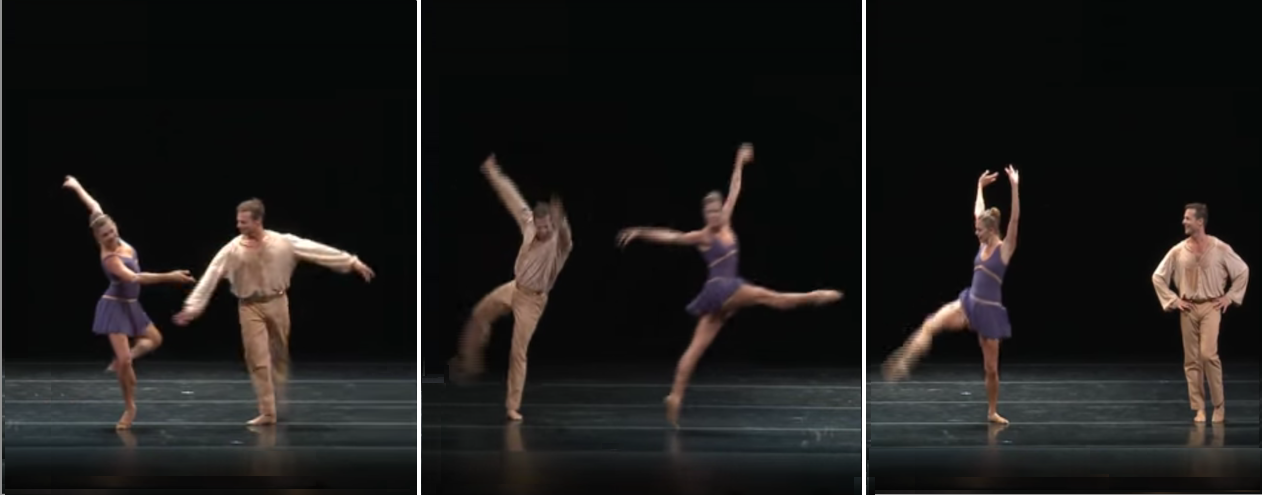 Tharp's light, ethereal, elegant duet, Diagonal, from the suite Preludes and Fugues, in its simplicity and clarity of movement embodies the Tharp's light, ethereal, elegant duet, Diagonal, from the suite Preludes and Fugues, in its simplicity and clarity of movement embodies the Apollonian aesthetic. Performed as part of Twyla Tharp's 50th Anniversary Tour of seventeen American cities. The supremely Apollonian aesthetic of Minimalism in art, music and dance became a kind of puritanism holding artists back from employing entertainments and tropes. Such puritanism was nowhere better expressed than in the famous 1965 "No Manifesto" issued by the Minimalist Judson dancer and choreographer, Yvonne Rainer. Rainer's spare approach to dance grew as much out of the political theory of another great Apollonian, the German dramatist Bertolt Brecht, whose distancing effect in theater came to inform the reductionist dictates of minimalist dance. Rainer's intent: to eliminate any and all elements in her staged performances (and later her films) that might lead to entertainments. Her method of negation says: "No to spectacle. No to virtuosity. No to transformations and magic and make-believe. No to the glamour and transcendency of the star image. No to the heroic. No to the anti-heroic. No to trash imagery. No to involvement of performer or spectator. No to style. No to camp. No to seduction of spectator by the wiles of the performer. No to eccentricity. No to moving or being moved."Those nostalgic for the days when artists, poets, filmmakers and dancers collaborated might say that Tharp devolved from the avant-garde, others that she transcended it. In either case she proved she was the modern choreographer best equipped to assimilate into a more popular dance form the lessons that theater integrated into its stagecraft as a result of the crises of modern civilization visited by the advocates of Existentialism, Pop Art, Minimalism and Structuralism in stripping the arts of all their ostentatious trappings and tropes in the mid- to-late twentieth century. This frailty of the current state of dramaturgy is particularly acute in theatrical dance when the choreographer seeks to make dance an instrument of the forces emanating from beyond the human origin, scale and sensibility -- say, when making the body conduit of historical revolutions, or as do the theater of various classical and tribal cultures of the remote past, when the dancer is invested with the omniscience of divinities. 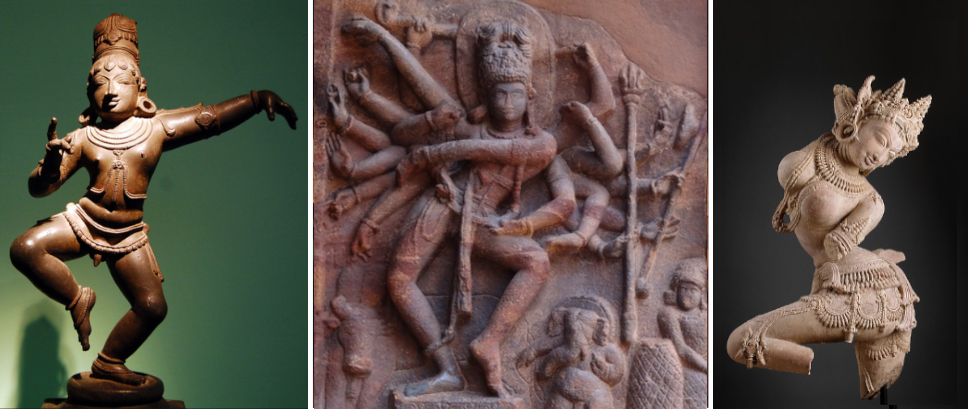 Dancing Indian Devas and Devis embody the sacred aspect of dance tied intimately to the creation, preservation and Dancing Indian Devas and Devis embody the sacred aspect of dance tied intimately to the creation, preservation anddestruction of the world. Every dancer knows the secret that the center of the universe that is the place of the cosmic dance of gods is within the heart of each living thing. Left: Bronze Chola sculpture of the boy-god Krishna dancing, 12th century, New Delhi Museum. Center: Sandstone sculpture of Shiva Nataraja, Cave at Badami, India, 534 CE. Right: Dancing Celestial Devi, sandstone, 12th century, Metropolitan Museum, New York. In modern dance, only Martha Graham famously achieved the balance required to make her dancers compelling vehicles of Fate or some malevolently intrusive deity or demiurge -- Graham's Clytemnestra (1958) and Phaedra (1962). But the era in which she created such dances, cultured audiences were still receptive to both modern adaptations of ancient myth and the aura of the tragedian. With the cinema and the magnification of realism in the close up having in the interim come to dominate the mediation of the dramatic repertoire of effective theater today, the former grand gesture even onstage is received by the audience not as some privileged glimpse of virtue but rather as the deadeningly self-conscious reflection on the actor and drama that it has become. In this respect, Tharp has always given every evidence of being acutely aware of what contemporary audiences for dance will tolerate, regardless of what walks of life they have followed to the theater. At 74 and in her fiftieth year as a choreographer, Tharp's Preludes and Fugues, Yowzie, and the two Fanfares set to the music of John Zorn, show themselves to be Tharp's most complexly ingenious staging of dance to date, as would be expected of any artist to have grown out of such an abrupt collision with the inhuman indifference to life that even a decade of reflections on our evolution as a race have not readied us to anticipate a terror equal to Islamic State. On that count it is arguable that violence and terror are not suitable subjects for dance as they are to literature and the photographic arts. But that is the Apollonian view. The truly Dionysian choreographer unleashed would by today's standards appear overwrought when attempting to portray terror in dance. By contrast the impotence that is felt in the face of terror lends itself to dance exceptionally, as Tharp shows us in Yowzie, because it is signaled entirely by underwhelming gestures and movements that suggest a persona that has become stunted or lost to oblivion. 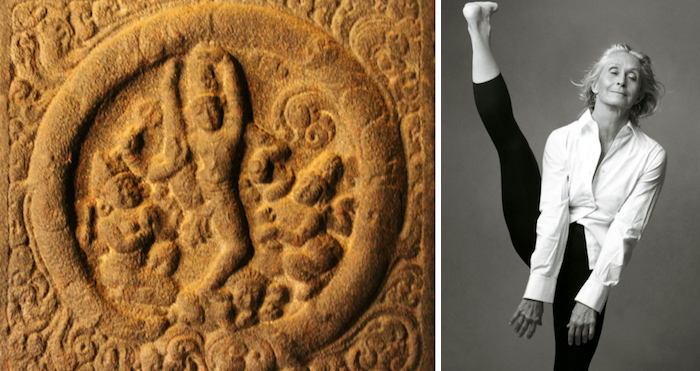 The Hindu god Shiva Nataraja performing the cosmic Dance of Bliss at the center of the Universe. In this 12th-century carved relief at the Airavatesvara Temple, in Darasuram, India, Shiva is seen finishing his contest with the goddess Kali by raising his leg straight above his head, the yogi Urdhva Tandava move that Kali cannot match. As if to show she can accomplish what the goddess Kali could not, Tharp at the age of 66 matches Shiva in this photograph by Annie Leibovitz for the 2007 Gap advertising campaign. The remarkable ease with which we can find Tharp's dances correlating the vernacular body language of today and the formulaic semiotics of cinema, television and the web to the greater legacy of art, philosophical and literary history conveys how profoundly rooted Tharps art is in the cultural, spiritual, and social rituals that are as much the universal root to modern ideologies and cultures as they are the required components of history. Tharp surely has looked to history when composing her version of the Bacchanalia that is Yowzie. Yet even when Tharp humorously correlates the vernacular visual languages of popular culture into a vaudevillian cabaret act of the Jazz Age or a 21-century rendition of HAIR, as she does in Yowzie, she retains a correspondence to the origins of such vernaculars in the anthropomorphic accounts of the world's mysterious physical forces as myths that have shaped the universe. In this regard Tharp's reveler's are more than the protagonists of the Roaring Twenties and the Swinging Sixties. Like the patchwork costumes her dancers wear throughout Yowzie, they are a pastiche of the troubled rebels of the millennia, extending back to a time when intoxication was honored as shamanistic entry to a spirit world in which dance was a vehicle for communion with powerful entities, animals and otherworldly experience. In this regard, it is enlightening to set the dances of Tharp's 50th Anniversary tour against the backdrop of a long line of art historical iconography informing the opposing principles of Apollonian and Dionysian art respectively at work in Tharp's Preludes and Fugues and Yowzie. Like all great artists, Tharp reaches across cultures and epochs with an eye for the most universally relevant signage to have impacted civilizations, even when she may not always remember or be fully aware of them. It is against this historical backdrop that Tharp's recourse to channeling the anguish of destruction and chaos to produce and promote its conversion into art participates in the mythopoetic enterprise -- that is the making of new myths relevant to the present day from the most vibrant myths and icons of the past. It is no accident that Tharp would recall Indian mythology, given that one of the most renowned and artistically serene representations of a god created by any race is that ubiquitous Indian icon of the Hindu god Shiva mediating creation and destruction -- each necessitating the other -- as Shiva Nataraja, the lord of the cosmic dance, whose magnificent rhythmic motion is attributed as the source of all movement and events throughout the universe.  Murder and Dismemberment of Pentheus by Bacchae, Fresco, House of the Vettii, Pompeii, Italy, 60--79 CE. The painting is one the great finds of the excavation of Pompeii depicting the death of the mythical King Pentheus of Thebes. After having forbidden the women of Thebes celebrating the god Dionysus, Pentheus goes the countryside to find the Bacchae. There the king is mistaken for a wild animal by the orgiastically-intoxicated women, is murdered and torn apart by his own his mother Agave, who does not learn of the tragedy until the morning after. The myth became renown after Euripides wrote and staged the tragedy, The Bacchae, in 410 B.C.E. The embodiment of Shiva Nataraja is also a conflation of the Apollonian and the Dionysian, or the Sublimation and Desublimation principles in one being, as no other mytho-godly incarnation admits. In such an all-consuming scheme as the cosmic dance, there can be no debauchery or destruction removed from the divine effects of cyclical creation, preservation and destruction. But there also can be no discipline too ethereal or no debauchery for the human embodiment of the godly impulse in all men and women, as all creation in formation and dissolution is encompassed by the dance of Shiva, and other gods of dance such as the goddess Kali. It is no accident or coincidence that both Shiva and Kali have both creator and destroyer aspects, as destruction is necessary for renewed and perpetual creation, or in the current zeitgeist terminology, sustainability is only achievable through efficient natural processes that facilitate death and birth in their turns. It may seem like a grand overstatement of Tharp's intent, but in fact in more human and secular ways, Tharp is employing the same mythopoetic process as that employed by the devotees to Shiva Nataraja who believe the sacred dance of the cosmos can in smaller human ways be applied to healing the trauma and adapting to the consequences of overwhelming chaos. We customarily call this process a catharsis, a working out or purging of trauma and the sense of profound loss in a series of small rituals that over time enable us to heal and to move forward with our lives. The concept of catharsis that comes to us from Aristotle's Poetics also was formulated as a justification for publicly staging tragedies that recall and incite anguish so to identify what must be purged from the body and mind to promote the health of the individual and the society. Tharp may dispense with the staging of tragedy and skip straight to catharsis supplied through dance as a collective ritual enabling us to cope with tragedy in it numerous visitations. There is no more valid justification for simple entertainment than catharsis, but neither is there a better account as to why the more complex arts are the more advanced means for completing the cathartic effort with high-minded ideals. The choreographer and the dancers heal through their ritualized and repetition of entertainment, then supply a more sustained enlightenment through art. Yowzie heals in making us laugh at our own follies, then sustains our minds by asking us to consider why we have socially advanced to a place that we can look in detached amusement upon our flaws. It is the meditation on the more artful aspects of Yowzie as a stark contrast to Preludes and Fugues that Tharp ultimately wages we will consider. Instead of concentrating on the alleviation of trauma through the methodical exercise of discipline as in Preludes and Fugues, Tharp makes us look at what happens to us when we abandon discipline and social principle to worship at the altar of hedonism. Here too there is a steep art historical legacy, this one by all appearances informs Yowzie even if only subliminally. That is the tradition of depicting the bacchanalia, for Yowzie is one such revelry in the truly pagan sense of being without a foundation in any truth but that of the final and in this case the desirable oblivion of intoxication. When seeking to understand the bacchanalia we must remember that beneath the hedonistic pleasures that promise to drown our sorrows is the deeply submerged, indeed the strongly repressed, desire to attain death. The bacchanal starts out as an adventure, as a celebration, as a distraction, but ultimately, as the drunken tears that ultimately come to succeed the modern and secular maenad and satyr remembers the pain and with that memory comes the desire for an end that is final and an afterlife is stillborn. The worship of Dionysius is not a mystical transcendence. It is a debauchery meant to cancel out the sacred, the godly, the moral -- whatever higher authority is perceived as victimizing the tortured soul. To Tharp's credit, she never lets Yowzie become sanguine. Her intent after all isn't to make us feel the pain of lost souls. For this reason beginning her performances with the exercises of Bach encourages us with its foresight of the alternatives to hedonistic surrender. 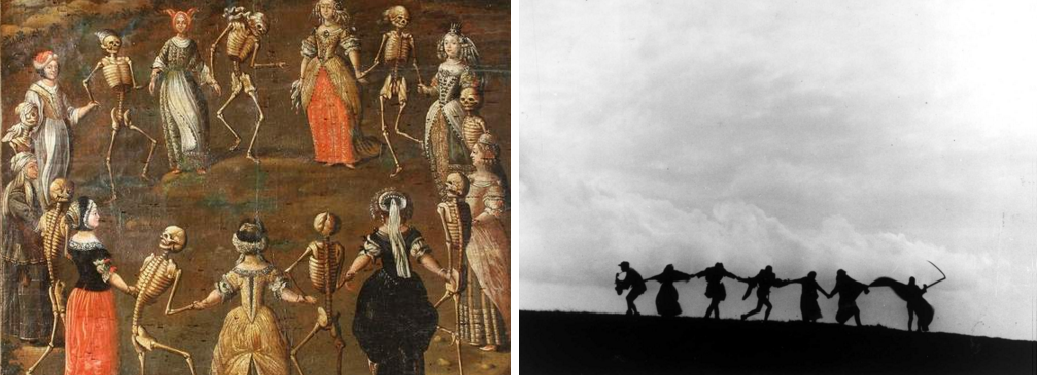 Left: Danse Macabre, tempera on panel, 15th century, Ethnographic Museum, Rzeszów, Poland. Right: The Danse Macabre still from the closing scene in Ingmar Bergman's allegorical film about The Black Death in medieval Europe, The Seventh Seal, 1957. Ultimately, however, the Protestantism of Preludes and Fugues and the hedonism of Yowzie must surrender to the greatest dance of all. Tharp may not have explicitly portrayed the Danse Macabre that acknowledges the universal submission to death, but its implication is the consequence of the denial of the dance's hedonistic subjects. The medieval mind may have been limited in its scientific capacity, but it it was better prepared in its ubiquitous acquaintance and obsession with personifying Death as an immanent shadow and envoy ready for our every move. The Dance of Death as the unifier of humankind without consideration of race, creed, ideology or station in life wasn't just an artist's anthropomorphism. The medieval proclivity for both personifying and comically endowing a human-skeletal Death as choreographer of the final dance to the grave is perhaps more enlightened than our modern relegation of death as an amorphous, impersonal death that can throughout life be stayed with age-defying surgeries, injections and cosmetics and postponed with hospital ventilation, circulation and feeding machines. Whereas the medieval dance of death, danced by commoners and nobility alike on popular religious feasts and painted in masterpieces today preserved in museums, reminded its cults of the vanity of youth, glory and power in precisely the same ironic and modest reflection as that the discerning viewer spies stalking the dancers throughout Yowzie. Listen to G. Roger Denson interviewed by Brainard Carey on Yale University Radio. Read other posts by G. Roger Denson on Huffington Post in the archive. Follow G. Roger Denson on facebook. -- This feed and its contents are the property of The Huffington Post, and use is subject to our terms. It may be used for personal consumption, but may not be distributed on a website.  More...
|


 Linear Mode

