
|
|
|||||||
| Register | FAQ | Calendar | Today's Posts | Search |
 |
|
|
Thread Tools | Search this Thread | Display Modes |
 04-07-2012, 03:13 AM
|
|||
|
|||
 Obama Embraces National Security as Campaign Issue

|
|
#1
12-03-2015, 10:30 PM
|
|||
|
|||
|
Neighborhood Slice: Into the Hearts of New York
"A place belongs forever to whoever claims it hardest, remembers it most
obsessively, wrenches it from itself, shapes it, renders it, loves it so radically that he remakes it in his image." - Joan Didion In New York City we have lived through stories rendered and shaped by many who have claimed and loved its streets, but the place can hardly be remade into one image, stereotype, culture or even nationality alone. A city once set on a new continent, what would later become the home of immigrants from all over, belongs to a unique category of people, New Yorkers, and therefore it belongs to the World. But to say that anyone in the World could be a New Yorker would be to miss the point entirely; they are a breed of a mix of cultures, customs and gentrification, accustomed to a fast changing pace of life. The analogy of different colors thrown on a canvas before the previous coat was able to dry comes to mind, making for pockets of living that can contrast wholly within the number of steps that takes one to cross a street. Neighborhood Slice, the documentary series from NYCLife, chronicles New York City neighborhoods through the eyes of those who have lived there the longest. It drops us in the heart of these unique divisions as we enter the lives and hear the stories of the ones who have shaped them. I sat with the creators of the show, Alexis Neophytides and Trina Rodriguez, two New Yorkers themselves, to find out why it was important to tell these narratives. 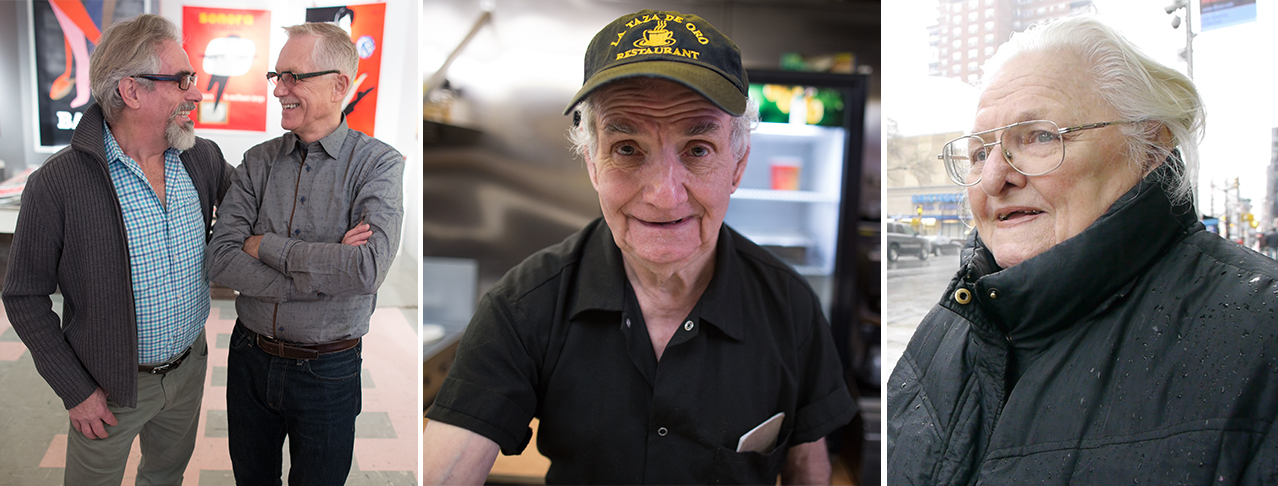 Where did Neighborhood Slice come from? Trina: We both live in Williamsburg, so we didn't have to look very far to see a neighborhood that was changing very quickly. A lot of the old stuff was going away and we thought it was important to capture that and tell the stories of the people who have been there for a long time, to capture that unique culture that they had created... Who are your subjects and how do you find them? Alexis: Older people who have seen a lot and can talk about the neighborhood and their lives in it through the past 40 plus years. Ideally is best to get to know the neighborhood, have a sense of what it was like through the different waves moving in. For example in Williamsburg, there were the Italian immigrants, then the Puerto Rican ones, and then the artists... Trina: Yes, people that came into the neighborhood in different waves: People that came in the 40s, 50s, 60s, 70s, 80s and 90s. Do you feel it's a discovery as you enter new neighborhoods? Alexis: For me it has been an interesting experience because I've been to most of these neighborhoods throughout my life because I grew up here, but I don't feel like I knew many of them well. I didn't realize that I didn't know them until we started spending time exploring and talking to people who have been there forever. We've been so lucky to find people who have opened their homes and their hearts. They are telling us their whole life history and they haven't, for most part, censored themselves. So it's been an adventure going through these neighborhoods. The last day we were scouting we were in the South Bronx in the morning and then we were on 8th Avenue in Sunset Park in the afternoon and we just couldn't believe it. It was like being in different countries! Trina: Such different worlds, everything was so different. That is what is so great about the city, each neighborhood has such a different culture, and I don't want to editorialize, but it sucks to loose that. Are the people you talk to upset about seeing the world around them change? Trina: It's kind of surprising, but talking to some of our subjects, they are open to the changes and for the most part they are positive about it, or have good humor about it. Obviously people miss things that were familiar to them, but the people we interview are still active, they are usually still working, they are still part of their community. I think part of growing older and being healthy is having a positive attitude. Also when you are older, you've seen a lot of changes. They've seen a lot of things happen to their neighborhoods, and to New York. In a way we may be the ones who look around the neighborhood and say, "What the hell is going on?" Alexis: They are wiser. Maybe we are more scared. We haven't bought houses yet, we don't have rent stabilized apartments, there is just more fear. Trina: Almost universally, the people that still own businesses own their buildings. Alexis: It's the only way they can afford to stay open. Do you think by doing the show you may be helping the older businesses? Marketing them for a younger generation? Trina: I don't hold any ideas that we are saving people's businesses, but I think we had the goal to make the kind of media that appeals to a younger generation, so that they would recognize the appeal of these things that exist in their neighborhood that have been there for years. And for the most part they are producing things that people still want, you know? People still want a cheap good meal, still want coffee and still want pastries. Any heartbreaking moments as filmmakers/ human beings in the making of the show? Trina: My heart is broken about La Taza De Oro (an old Puerto Rican diner from the Chelsea episode), which is currently closed. The last I spoke to Maria (the owner) they were trying to reopen, but the building next to theirs had collapsed, so the structure of their building needs review. They have to separate their façade from the building next door, and now all the people who worked there have lost their jobs, and Maria and her husband lost their home because they lived above the restaurant. That breaks my heart. I know that they are struggling right now to try to reopen. Alexis: There was a lovely Greek man from Prospect Heights, Gus, who passed away. He wanted to take us out to dinner in Astoria, which we never got to do. We were lucky to get to know him and make a piece on his restaurant, which has been there for 80 something years. His father opened it when he first moved to America. That was really sad. What would you say your goal is with Neighborhood Slice? Trina: Ideal situation, I would like for people to think about what makes a neighborhood a neighborhood, and to inspire people to be more involved in their neighborhoods and appreciate the people around them. Alexis: And to celebrate their communities, and maybe go around and celebrate other communities. What is next? Alexis: We have a list of potential people and neighborhoods for next season we are getting started on; Crown Heights, Harlem, the East Village, Upper West Side...we have some interviews already... We are saving the world. (laughs) Neighborhood Slice airs Wednesday nights at 8:30pm on NYCLife (Channel 25). Episodes can be watched online at nyc.gov/media or www.neighborhoodslice.com -- This feed and its contents are the property of The Huffington Post, and use is subject to our terms. It may be used for personal consumption, but may not be distributed on a website.  More...
|


 Linear Mode

