
|
|
|||||||
| Register | FAQ | Calendar | Today's Posts | Search |
 |
|
|
Thread Tools | Search this Thread | Display Modes |
 04-07-2012, 03:13 AM
|
|||
|
|||
 Obama Embraces National Security as Campaign Issue

|
|
#1
12-04-2015, 06:24 PM
|
|||
|
|||
Here Are The 10 Dirtiest Places In Every Supermarket
 Photo Credit: Pixabay Plan on going grocery shopping soon? Read this first. Let's face it: Everything around us is pretty dirty. Even if we wash our hands regularly and make sure that our living and working spaces are clean, the world is still an insanely germy place. Unfortunately, the same can be said for where we buy (and eat) our food. These are the 10 dirtiest places in every supermarket. Click Here to see The Here Are the 10 Dirtiest Places in Every Supermarket As a rule of thumb, the most bacteria tends to lurk in the places that are touched by the most people. Bathroom sink faucets, light switches, condiment bottles and menus in restaurants, door knobs and handles, computer keyboards and mice, and ATM keypads have been shown to harbor an insane amount of germs. Flu viruses can survive on hard surfaces for as long as 18 hours. On top of that, The Centers for Disease Control and Prevention estimates that 200,000 Americans contract food poisoning every day, largely by touching something that's contaminated then transferring the bacteria or pathogen to the eyes or mouth. At the supermarket, where everyone seems to be touching everything (seriously, how often have you picked up an apple there and then put it back down?), there's also food everywhere, including raw meat. Nowadays just about every supermarket has hand sanitizer by the entrance; we suggest you use it on your way in and on your way out. Click Here to see The Here Are the 10 Dirtiest Places in Every Supermarket Slideshow It's easy to freak out about germs being everywhere. While it's certainly unpleasant to think about, unless you're very young, very old, or have a compromised immune system, you're most likely not going to become deathly ill from a trip to stock up on eggs and milk. We have antibodies and an immune system whose job it is to make sure that bacteria are killed before they can cause us harm. That said, you should still wash your hands before you dive into that newly-purchased bag of Cheetos. Checkout Counter 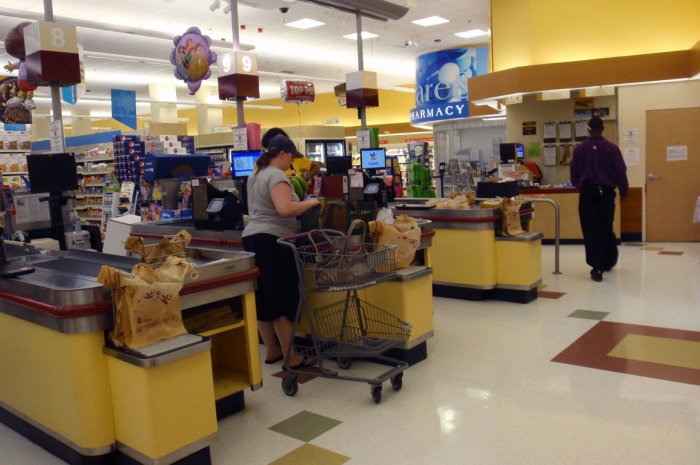 Photo Credit: Flickr / Daniel Lobo / CC BY 4.0 Think of all the things that come into contact with the checkout counter: money, your hands, the bottom of your purse (which most likely recently touched a bathroom floor)... all of these things are infested with germs. Conveyor Belt 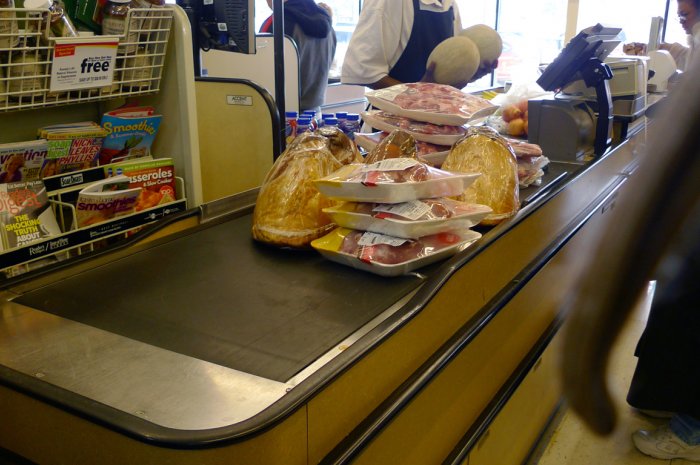 Photo Credit: Flickr / Thirteen of Clubs / CC BY-SA 4.0 The conveyor belt on the checkout line is rarely, if ever, cleaned, and can last for up to 30 years. On top of that, they're made from petroleum-based PVC, which is porous and nearly impossible to clean. A study by the International Association of Food Protection showed that yeast, mold, staph, and coliform live and grow on the belts, and a study by Michigan State University found bacteria on 100 percent of belts tested. Click Here to see The Here Are the 10 Dirtiest Places in Every Supermarket Credit Card Keypad  Photo Credit: Flickr / Bill Smith / CC BY 4.0 Just about everybody pays for their groceries with credit cards, and you can't use your credit card without using a keypad, or at least using that "pen" to sign your name on the screen. The more that human hands touch something the filthier it will be. We highly doubt that those keypads are being cleaned daily. Deli Slicer 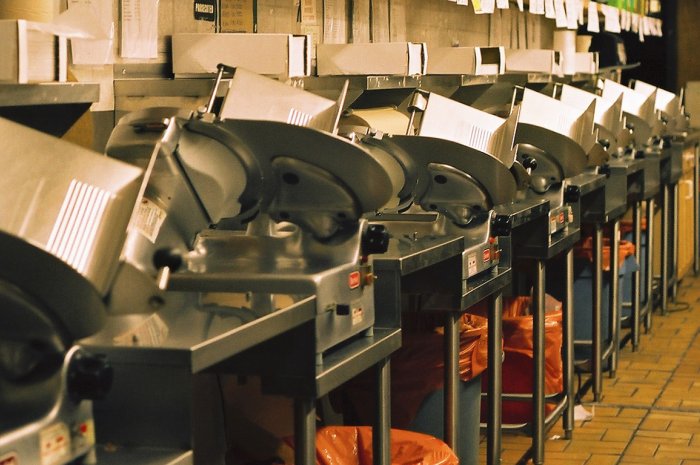 Photo Credit: Flickr / Taz / CC BY 4.0 The deli slicer, and the cold cuts that it slices, are at serious risk of contamination. If the blade isn't regularly cleaned, it can transfer bacteria (including listeria) to everything it touches. A joint team of researchers from the USDA, FDA, and CDC sampled deli meats at the point of purchase, and three percent tested positive for listeria. Click Here to see The Here Are the 10 Dirtiest Places in Every Supermarket Fruit  Photo Credit: Flickr / Mike Licht / CC BY 4.0 There's a reason why we're told to wash fruit before eating it, and it's about more than removing pesticides. It's commonplace to handle fruit before buying it. Ready-to-eat fruits like apples and peaches can be touched by dozens of people by the time you get to it. Dents or bruising in fruit can provide a way in for pathogens, while pre-sliced fruit might have been cut with a dirty knife or by someone with dirty hands. Click Here to see the Original Story on The Daily Meal Dan Myers, The Daily Meal More Content from The Daily Meal: 10 Ways Supermarkets Trick You Into Spending More Money 11 Secrets Supermarkets Don't Want You to Know How Do Supermarkets Dispose of Expired Foods? 10 Ways You're Wasting Money at the Supermarket America's Best Supermarkets 2015 -- This feed and its contents are the property of The Huffington Post, and use is subject to our terms. It may be used for personal consumption, but may not be distributed on a website.  More...
|


 Linear Mode

