
|
|
|||||||
| Register | FAQ | Calendar | Today's Posts | Search |
 |
|
|
Thread Tools | Search this Thread | Display Modes |
 04-07-2012, 03:13 AM
|
|||
|
|||
 Obama Embraces National Security as Campaign Issue

|
|
#1
03-16-2016, 11:29 PM
|
|||
|
|||
|
Beauty and Balance in the Boreal
To mark the International Day of Forests in 2016, here are 16 reasons to celebrate one of the planet's largest intact ecosystems.
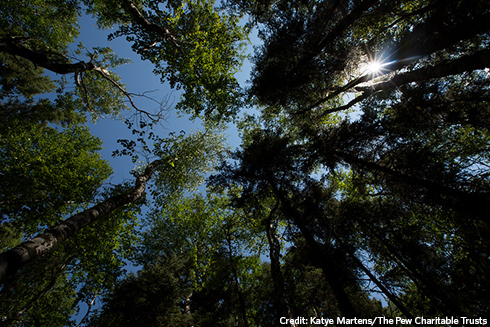 Reach for the sky: Boreal birch trees stretch toward the sun near The Pas, in northern Manitoba. What does a billion acres of intact forest look like? It's a question worth considering. If you were to fly over Canada's immense boreal region--a plane ride that would take most of a business day--you could see the answer firsthand and enjoy scenery as splendid and diverse as the country itself. In the southern boreal, dense stands of mature spruce and pine trees form an imposing canopy over the landscape. Farther north, smaller trees thin out in their gradual approach toward the Arctic tundra, revealing the austere beauty of the rocky taiga shield. In between, the region shimmers with water--a forest of blue that includes vast stretches of wetlands and fens, as well as some of the largest freshwater lakes in the world. In the far reaches of the Northwest Territories and Yukon, the snow-capped peaks of the Mackenzie and Saint Elias ranges extend their jagged reach far above the tree line. The boreal seen from above is, in a word, breathtaking. From the ground, the forest shows a different side. In the spring and summer, the trees and wetlands are alive with billions of migratory songbirds, shorebirds, and waterfowl that populate North America's bird nursery, one of the most important avian breeding areas on the planet. Grizzly bears, wolverines, lynxes, wolves--species that have lost much of their original range in North America--add to the region's bounty of biodiversity. Another rich treasure is locked within the soils and wetlands: enormous stores of carbon that have accumulated over millennia and play a critical role in mitigating the impacts of climate change. But like the rest of the world's last remaining wild places, the boreal is under constant pressure, threatened by fragmentation from increased resource exploration and industrial development, and more frequent and intense forest fires caused by warmer, drier weather. The challenges and stresses threatening the boreal are often overshadowed by the spotlight on the pace of destruction in tropical rainforests such as the Amazon. Yet there is good news for Canada's boreal: Efforts to ensure the ecological integrity of the region are bringing together indigenous communities, industry, conservation groups, and governments at all levels that seek a balance between environmental protection and sustainable economic development. As the world marks the International Day of Forests on March 21, here are 16 photographs that illustrate why the boreal is special--and why its conservation is so vital to the planet. 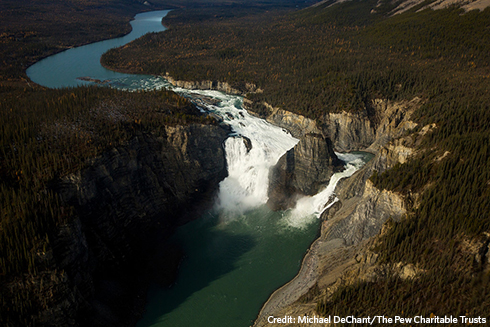 Virginia Falls--part of the 7.4 million-acre Nahanni National Park Reserve, a UNESCO World Heritage site in the Northwest Territories--is twice the height of Niagara Falls. More than 80 percent of Canada's boreal forest is still relatively intact and free of industrial disturbance. 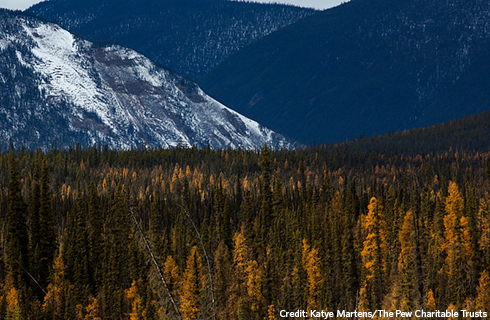 Towering tamaracks add a splash of autumn yellow against the backdrop of the Mackenzie Mountain Range in the Northwest Territories. The boreal covers 1.2 billion intact acres of northern Canada and stretches more than 5,000 kilometers (3,000 miles) from the Yukon to Newfoundland and Labrador. 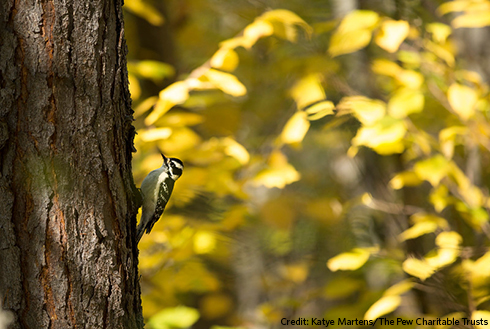 A female downy woodpecker pauses on a tree in northern Alberta. Each spring, 1 billion to 3 billion birds migrate north from as far away as South America to nest in Canada's boreal forest. After a successful breeding season, between 3 billion and 5 billion return south each fall. 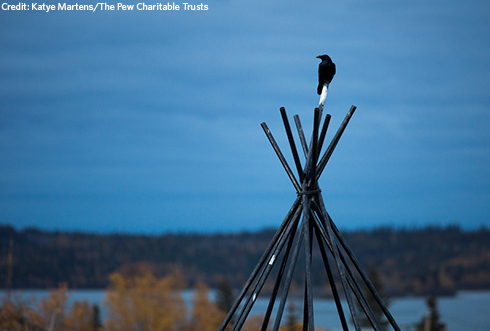 A common raven perches atop a tepee frame in Yellowknife, Northwest Territories. More than 600 indigenous communities make their homes in the boreal forest--and, through land-use planning based on traditional ecological knowledge and modern science, First Nations are emerging as leaders in efforts to balance conservation and sustainable development. 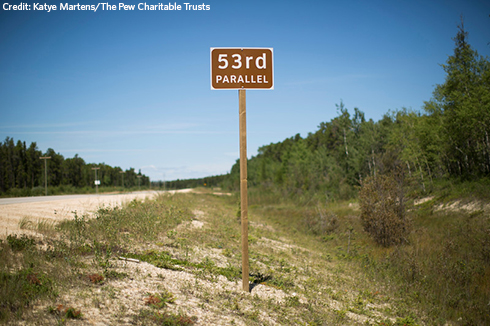 This highway sign is considered the unofficial beginning of "the North" in the province of Manitoba. The boreal region covers 140 million acres in the province, where about 80 percent of the boreal forest--some 115 million acres--remains intact. 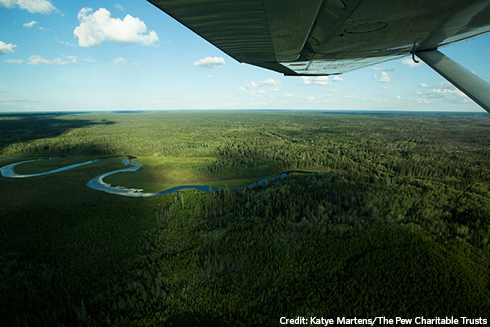 A slow-flowing creek snakes through forest stretching to the horizon in Grass River Provincial Park, near Cranberry Portage, Manitoba. The boreal represents 25 percent of the world's remaining intact forest. 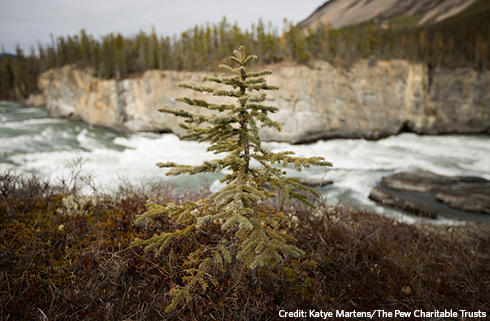 A spruce tree puts down its roots on the rock cliffs above Virginia Falls, Northwest Territories. There are about 20 species of trees in Canada's boreal forest. 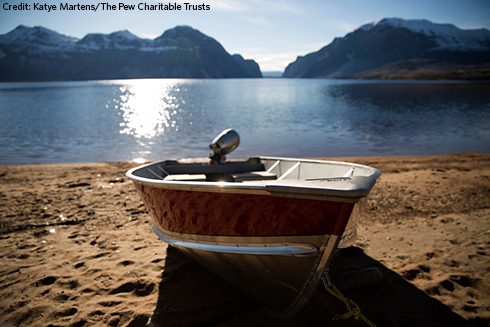 The afternoon sun reflects off a fishing boat and the still waters of Little Doctor Lake, Northwest Territories. Nearly half of the world's lakes larger than 247 acres (1 square kilometer) are found in Canada's boreal, a region that holds 600,000 lakes larger than 25 acres. 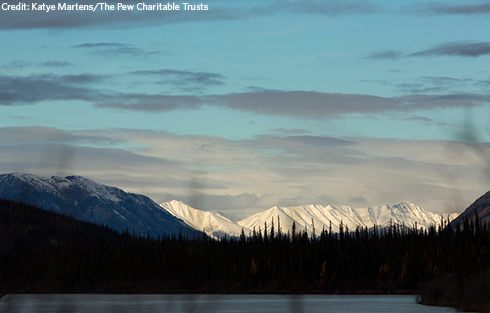 The Mackenzie Mountains loom above trees lining the 335-mile-long South Nahanni River, considered one of the world's great wilderness rivers. Canada's boreal region contains the largest number of undammed river systems in North America. 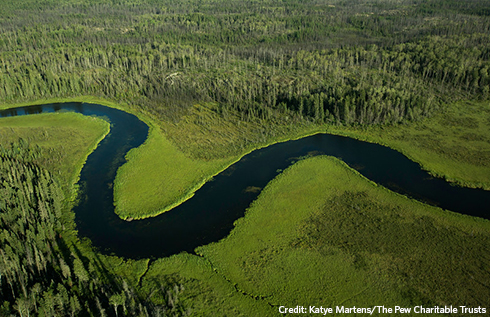 Boreal wetlands, like these in northern Manitoba, store twice as much carbon per acre as tropical forests. Canada's boreal region contains 25 percent of the world's wetlands. 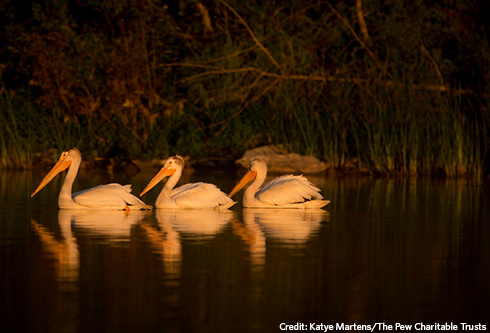 White pelicans and other shorebirds find critical habitat in the boreal's wetlands. Canada's boreal forest and peatlands lock in a minimum of 208 billion metric tons of carbon, helping to cool the planet. 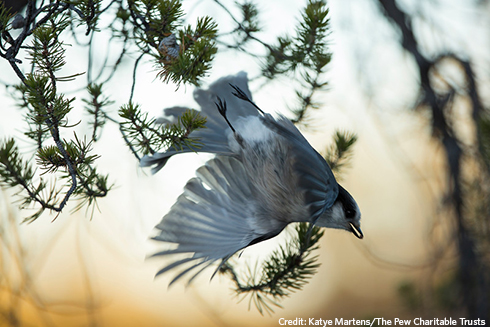 A gray jay takes wing near Yellowknife, Northwest Territories. More than 300 bird species nest in, or regularly migrate through, the boreal region. 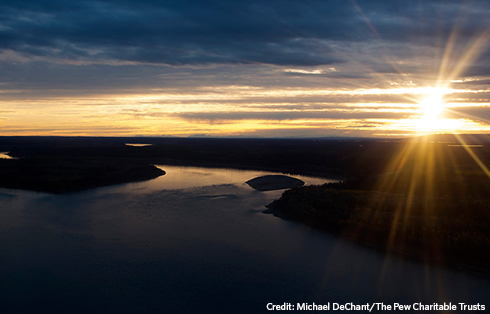 The sun sets along the 1,080-mile-long Mackenzie River in the Northwest Territories. Known as the Dehcho to the indigenous Dene people, the Mackenzie is the second-longest river system on the continent, second only to the Mississippi, and flows north into the Beaufort Sea. The boreal region includes five of the 50 largest rivers in the world. 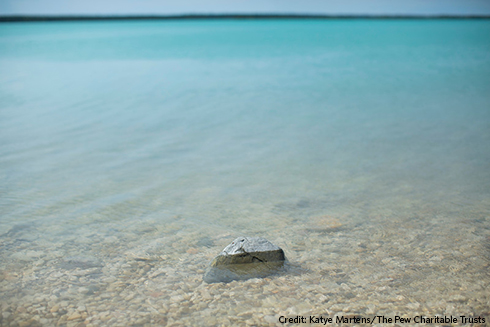 The waters of Little Limestone Lake, in northern Manitoba, turn turquoise in the warm summer months when calcite from eroded limestone is released from the lake's bottom. In all, Canada's boreal region holds almost 200 million acres of surface freshwater, more than anywhere else on Earth. 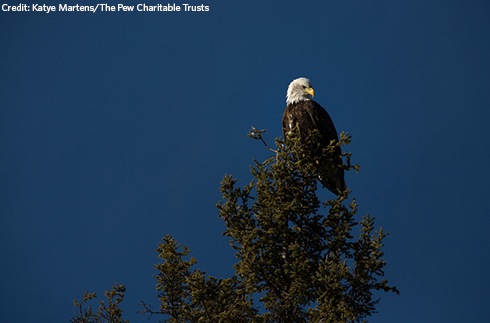 A bald eagle surveys the landscape in the boreal forest near Fort Simpson, Northwest Territories. The boreal region in the Northwest Territories covers 235 million acres and is a breeding ground for 150 million to 500 million birds of more than 200 species. 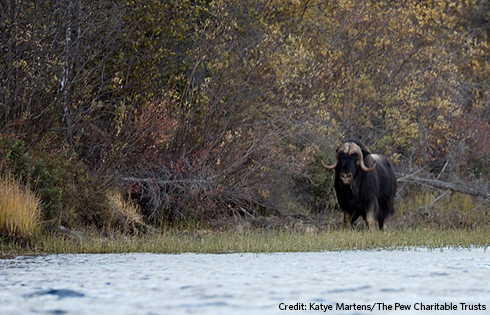 A musk ox grazes along the banks of the Snowdrift River, near Lutsel K'e, Northwest Territories. Canada's boreal is home to more than 85 mammal species, including many that are rare and endangered elsewhere. -- This feed and its contents are the property of The Huffington Post, and use is subject to our terms. It may be used for personal consumption, but may not be distributed on a website.  More...
|


 Linear Mode

